
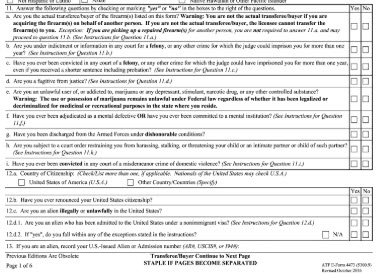
After a prospective transferee/buyer completes Section B of the 4473, do you verify their answers to the “Yes/No” questions, you know, the questions that determine if they are prohibited or not? Are you using the memorized pattern of expected answers?
What do you do if a prospect answers a question opposite to the expected answer? Do you just chalk it up to a failed sale and ask the prospect to leave your establishment? Or do you interview the prospect to determine why they answered the question in the manner they did? Maybe the customer didn’t fully understand the question. Maybe they had a different thought in their mind when they selected their answer. Or maybe English is not their first language. But do you take the time to find out? If not, you should. Maybe in the prospect’s mind, they associated “actual buyer” with “actual owner”. What if the prospect wants to buy a firearm for their spouse, as a bona fide gift? In thinking that, maybe the prospect answered “No” when they should have answered “Yes”. But do you take the time to find out?
But let’s say you do your due diligence and interview the prospect. What questions do you ask? Is it one question or multiple questions? (Remember, your ATF license could be on the line if you permit a prohibited person to walk out with a firearm.) Is it the same set of questions for each respective “Yes/No” question?
FFLAssist makes this interviewing process a breeze. You, as the dealer, determine, create, or conjure up which questions to potentially ask the prospect for each of the “Yes/No” questions. For example, for question 21.a., “Are you the actual buyer…?”, you could create a list of specific questions to ask regarding this question. You could create the following sample questions:
- Why did you answer the question in the manner you did? (Let the prospect tell you)
- Do you understand the question? (Maybe English is not their first language)
- Are you buying a firearm as a bona fide gift? (Say…a spouse)
- Is that gift recipient legally prohibited from possessing firearms? (Convicted felon?)
- Did you simply fat-finger the answer before fully reading the question?
Then, during the interviewing process, after you have reviewed their Section B answers, you simply cherry-pick the questions you want to ask to address their original answer to question 21.a. This cherry-picking is on a prospect-by-prospect basis. You may choose to ask every prospect every question, or you may select specific questions to ask, depending on the prospect sitting in front of you. You need to feel out your prospect.
Then let’s suppose you talk with the prospect and you believe their answer. On paper 4473s, you give the 4473 back to the prospect and instruct them to simply cross out their wrong answer, check the correct answer, and initial on the very slim right margin, which is acceptable to the ATF.
But crossing out, rechecking, and initialing cannot be done on a digital 4473. Within FFLAssist, there is a “Section B Correction” wizard, completed by the prospect, which guides them through correcting their answers, so their corrected answer can be digitally recorded.
So, what FFLAssist does is build a “Dealer Questions” log for every 4473 in which prospects provide opposite answers to the “Yes/No” questions. This log is then available to the dealer to open and simply ask the questions contained in the log.
So, if the prospect answers “No” to question 21.a., the log will contain the five (5) questions listed above, which YOU, the dealer created. You simply pick which question(s) to ask.
If the prospect answers “No” to question 21.a., and “Yes” to question 21.f., “Are you a fugitive from justice?” the log will contain questions to ask to seek answers for both 21.a. and 21.f.
If you, as the dealer, believe or trust the prospect’s answers, on the specific 4473 Dealer Question log, you simply place a check mark in a “Proceed” check box field at the top of the log page. Doing so permits the prospect to complete the “Section B Correction” wizard. If you sense the prospect’s answers are sketchy, then simply leave the “Proceed” check box unchecked, and the prospect is now prohibited from completing the “Section B Correction” wizard.
At this juncture, the prospect’s replies to the questions you ask are not being recorded. The reason is that unless you take shorthand, you may not be able to type fast enough to keep up with the prospect’s answers. But the concept of recording replies is being considered and may be included in a future release of FFLAssist.
But, by using this Dealer Questions functionality, you are demonstrating to the ATF that you are doing your due diligence by trying to get into your prospect’s head why they answered the “Yes/No” question(s) in the manner they did, and why they needed to be corrected.
